
Know who your company can’t afford to lose.
Build their digital twins.
BusFactor finds the people your company runs on, with the evidence, and builds an Imprint of the ones you choose: a digital twin to consult, not replace.
 Purdue HIVE, inaugural cohort
-
“We didn’t realize how much ran through them.”


 Texas A&M AIVVC, top 27 of 531
How it works. From the systems you agree to an Imprint of the people you choose.
Nobody fills in a survey. It reads the records your work already leaves behind and shows its working.
Demo data. Roles shown, not names.
Two minutes of the product. The readout, the evidence and an Imprint, recorded from the app.
Connectors for these tools. An export for anything else.
 Slack
 Google Workspace
 Microsoft 365
 Outlook
 GitHub
 Atlassian
 Salesforce
 HubSpot
 Notion
 Asana
 Monday
 Workday
 BambooHR
 SAP SuccessFactors
 ADP
 Dynamics 365
 SAP
 Oracle
 NetSuite
 QuickBooks
 ServiceNow
 Zendesk
 Freshdesk
Not listed? Ask on the call.
-
42%
of what a role depends on is unique to the person holding it.
-
4.1years
median time a US worker stays with one employer.
-
1 in 3
acquired startup employees leave within a year of the deal.
Sources: Panopto with YouGov, 2018, self-reported; US Bureau of Labor Statistics, January 2026; J. Daniel Kim, MIT Sloan, US Census data (33% against 12% of comparable regular hires).
Four moments. One readout.
-
Someone hands in notice, or a new hire has the questions one person could answer. The team consults that person’s Imprint instead: a digital twin of what they know, for consulting, not for replacing them. It answers with sources. The readout itself tells a manager where the team’s work really runs, and what a handover between two people has to cover.
- Someone hands in notice
- A new hire’s first weeks
- A handover
- Mapping a team
-
-
-
Your data stays yours. Built for your security review.
Scope
What this deployment may read.
-
In scope
Slack
-
In scope
Google Workspace
-
In scope
Jira & Confluence
-
In scope
Workday
-
In scope
Salesforce
-
Not read
NetSuite
-
Not read
Personal channels
-
Not read
Anything you untick
- Scope
- Everything starts ticked. You untick any tool, team or person.
- Deployment
- Your server or ours. The on-prem kit runs inside your infrastructure; file export works with no connector.
- Compliance
-
SOC 2 Type IIIn progressData processing addendumSecurity whitepaper
- People
- Not a monitoring tool. People who are flagged see their own evidence.
- Access
- Who may consult an Imprint is granted by role and expires; every scope change is an audit event.
- AI provider
- Named in the DPA. On your server, your own key.
FAQ
What buyers ask first, security included.
All of it, unless you tell us otherwise. Everything starts ticked and you untick any tool, team or person we may not read. It runs on your server or ours, inside the scope your security team agrees.
Yes. Your server or ours. The on-prem kit runs inside your infrastructure with zero-egress tiers and your own model key. File export works when there is no connector.
No. It measures where the work runs, never performance. The readout shows roles; names stay inside your deployment, and anything shared outside it shows roles only. The people who are flagged see their own evidence.
You know the obvious senior names. What gets missed is the quiet bridge: the one person two teams both route through, who is on nobody's list. Closing that gap is the product, and every flag carries its evidence so you can disagree with it.
Nothing to start. A file export from your HR system, ticketing tool, project tool, CRM, ERP or mail server is enough for a first readout. Connectors exist for the common tools when you want them, and you choose which ones.
About a month from scope to readout for one team: a week to scope, two weeks to read and find, the readout in week four. Nobody fills in a survey. Spanish-language records, product and output are supported.
No. It is a consultable twin of what they know, with their consent. It answers questions with sources. It does not do their job.
Founders and CTOs of funded companies of fifty to five hundred people, heads of operations, and the deal teams buying or integrating them. Per person per month for ongoing use, project pricing for a deal. No public price list yet; a thirty-minute call is the fastest way to a number.
Tayseer Abdeljaber. Industrial engineering, Purdue.
At fifteen I interned on Altibbi’s AI team, next to the head of HR. She spent a month of interviews asking who the company depended on, with no clear answer: people hesitate to say what they actually do. The work itself does not.
More than a hundred buyers have since told me a list of who is critical is only a warning. They need to keep what those people know. That is what the Imprint is for.
“Build real things before you feel ready, and get them in front of real people as soon as you can.”
 LinkedIn

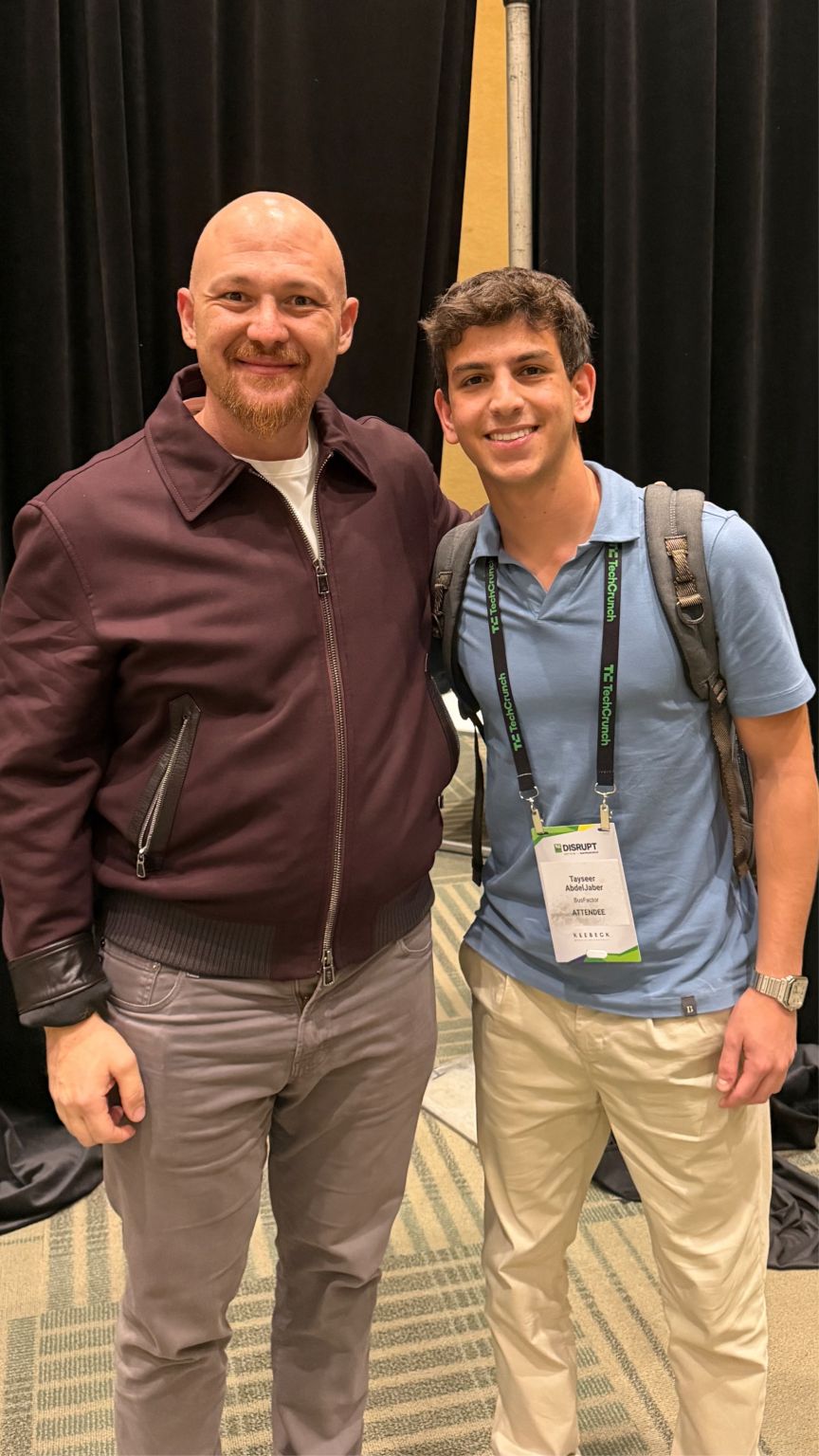
Photographs: at the fountain, Purdue University, Edwardson School of Industrial Engineering; at TechCrunch Disrupt, from the founder’s LinkedIn post.
Know who you can’t afford to lose. Start with one of your teams.
A 30-minute call: what a readout on that team would contain, and which Imprints you would keep.
Book a 30-minute call